Laws
A law is only as good as your ability to prove it was followed.
In 1942, Isaac Asimov imagined three laws to keep robots from harming us. Eighty years later the robots are real — and the laws are still just words until someone can prove a machine actually obeyed them.
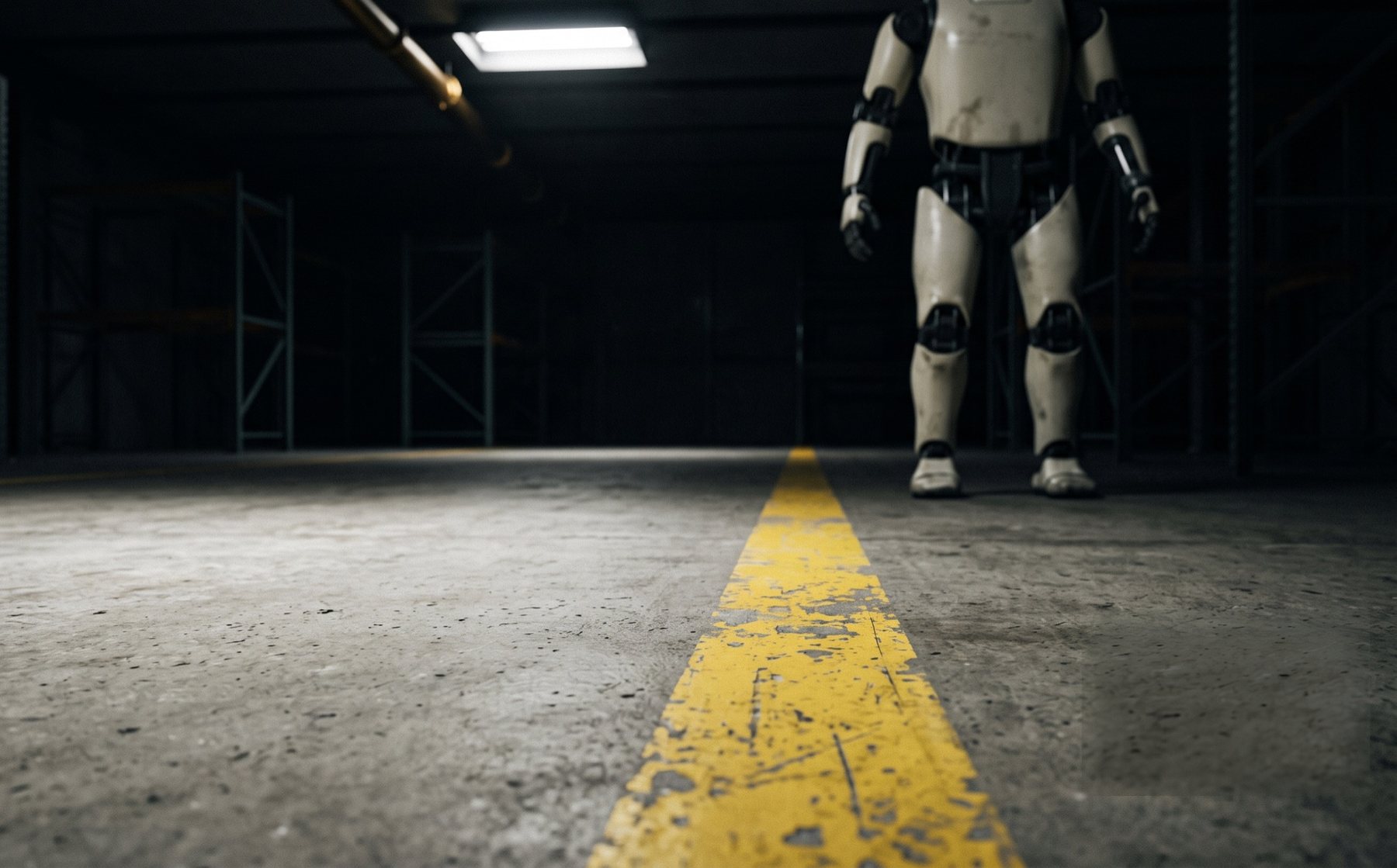 EX-09 / THE LINE
 The three laws of robotics
As Asimov wrote them.
- First Law
A robot may not injure a human being or, through inaction, allow a human being to come to harm.
- Second Law
A robot must obey the orders given (to) it by human beings, except where such orders would conflict with the First Law.
- Third Law
A robot must protect its own existence, as long as such protection does not conflict with the First or Second Law.
The law that was never written
You cannot enforce what you cannot prove.
Every one of Asimov’s laws assumes something no one has actually built: a way to know, independently and beyond dispute, what a robot sensed, decided, and did. A rule no one can verify is not a safeguard. It’s a hope.
And when the proof of a machine’s behavior is held only by the company that built it, “trust us” is the entire safety argument. That is not good enough for machines that act in the physical world, around real people, with real consequences.
We’re not here to write the laws of robotics.
We’re here to make them enforceable.
The future of autonomous machines shouldn’t rest on fear — or on faith. It should rest on proof. That’s what we’re building.